Online Merker
Rollercoaster to the afterlife
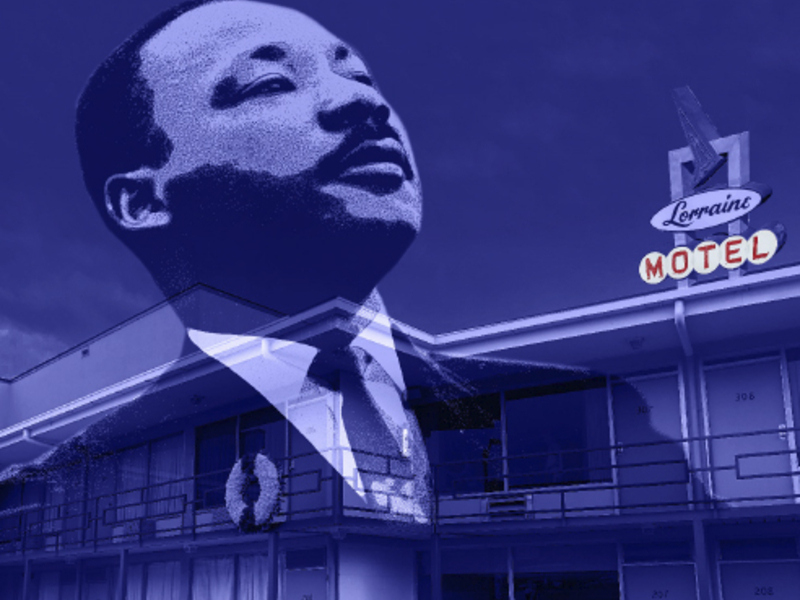
A simple motel room in Memphis, Tennessee. Today, this Lorraine Motel is a Museum for the Civil Rights Movement, because history was written there... We now meet Martin Luther King on stage in room 306. He is alone and “rehearsing”, so to speak, the next speech with which he wants to inspire the black population and reach and shake up the white population. The year is 1968 and the struggle for the civil rights of the black population is shaking the United States. King orders a a coffee from room service.
While a thunderstorm rages outside, there is a knock at the door and a chambermaid appears with a tray. And this is where the amazing, rightly award-winning play by American PoC author Katori Hall really begins. She skilfully misleads the audience, constantly tackling new themes in a veritable rollercoaster ride - and in the end dares to do something truly astonishing.
At the beginning, everything seems “normal” in a way, a famous man in his prime (King was 39 at the time), an attractive young woman named Camae, who is not intimidated by him and even shares her cigarettes with him. It is noticeable that King is either afraid of thunderstorms, flinching at every clap of thunder, or deeply scared of further attempts on his life at all times... Camae proves to be comforting, the two flirt with each other to a certain extent, and although King calls his wife in between and proves to be a loving family man, one would not be surprised if the two ended up in a hotel bed together... But that would be rather trivial for the last night of a life - for it is April 3. The following day, King will meet his death from the gun of criminal James Earl Ray...
(…) The play is a delicate balancing act, and director Adrienne Ferguson manages it effortlessly because the extraordinary power and presence of her two actors. Samson Ajewole brings all the nuances to the charisma of an important leader, who is in many ways just a normal, likeable man, and Davida Opoku sweeps across the stage like a little she-devil, full of surprise with every line she speaks (…)
Renate Wagner
ORF.AT
Martin Luther King’s Last Night On Stage
On April 3, 1968, King gave an acclaimed speech entitled “I've Been to the Mountaintop”. He had seen the “promised land” and was therefore no longer afraid, said King. He advocated a non-violent struggle against oppression and injustice. On April 4, 1968, he died in an assassination attempt. The play begins after his last speech. King is exhausted, in a hotel room, far away from his family. He orders a cup of coffee, which is brought to his room by a young hotel employee. A flirtation develops with the cheeky and witty young woman. But the story does not develop as one might expect - several surprising twists and turns determine the plot.
From social politics to spirituality
The narrative level is just one of several layers in this complex work by US Pulitzer Prize winner Katori Hall. Personal matters naturally play a role in the clever, quick-witted dialogue full of humour between the two, but the range of topics goes far beyond this. Socio-political issues are addressed, such as the structural discrimination of the African-American community, hatred, poverty and violence. But spiritual themes also feature prominently: Mercy, for example, or dealing with one’s own mortality and what (perhaps) comes after death.
A plea for hope
Katori Hall manages the feat of dressing difficult topics in light-footed, entertaining dialogue and always incorporating extremely credible encouragement, even in the face of dark situations – for example, a key quote from Martin Luther King: “Only when it’s dark can you see the stars”. For lead actor Samson Ajewole, this is still a meaningful sentence today, as he explains in an interview with religion.ORF.at: “What I find so beautiful about the play is that it gives hope”, says Ajewole.
Extraordinary things can be achieved if traditions such as those established by Martin Luther King are continued: When you focus on unconditional love for all human beings. “It’s simply about realizing this legacy in the here and now. And I think that’s what we’re doing with this play. That’s why it’s such a pleasure to bring it here to Vienna,” says the lead actor.
Characters change
It is exciting to follow the development of the two characters over the course of the play as they change and grow together through their encounter. The maid Camae, who reveals more and more wisdom, and the acclaimed preacher, who changes from a public leader, a great symbolic figure, to a private person in an exceptional existential situation.
The characters in “The Mountaintop” develop in surprising ways. Director Adrienne Ferguson describes it like this: “There’s this feisty young girl with so much practical life experience. And she meets this academically educated man. The more the play develops, the more they are on an equal footing with a very deep respect for each other, beyond flirting. And what many in politics currently fail to realize is that the best people are those who can learn from others. And that is exactly what he does. He is discovering humility and letting go of his ego.”
Promised land without injustice
If you want to see it this way, you can also see parallels in the development of this character to how the Gospels portray Jesus of Nazareth: learning from women, dealing with the socially excluded, radical love paired with clear-sighted social criticism and the painful confrontation with his own mortality.
Jesus of Nazareth gave the famous Sermon on the Mount and Martin Luther King spoke in his last speech about standing on a mountaintop and seeing the promised land: A land without hunger, without war, without rich and poor. A land where skin color makes no difference. A country where charity reigns.
These are poetic words, strong words, says lead actor Samson Ajewole, which he is happy to pass on to the audience. “The Mountaintop” is a clever, multi-layered play, touching and witty. Never patronizing, never unctuous - and radically encouraging.
Brigitte Krautgartner